
Technical Guide
Thermocouple vs RTD (PT100): How to Choose the Right Sensor and Cable
Thermocouples and RTDs both measure process temperature. The right choice depends on how hot it gets, how accurate the reading must be, how the sensor is mounted, and how far the cable runs to the instrument. This guide covers each, then the part most often got wrong: the cable.
| Property | Thermocouple (J, K, T, E, R, S) | RTD (PT100) |
|---|---|---|
| Temperature range | Widest. Base-metal types cover sub-zero to high temperatures; R and S (platinum) types go highest. The exact limit depends on type, wire size and sheath. | Low to moderate temperatures. The usable range depends on element construction and accuracy class (see IEC 60751). |
| Accuracy | Good. Tolerance classes are set in IEC 60584. | Better. Tolerance classes AA, A, B and C are set in IEC 60751. |
| Stability / repeatability | Can drift over time, especially at high temperature. | Very stable and repeatable over long periods. |
| Response | Usually faster, especially with a small or grounded junction. | Usually slower, because the element is larger. |
| Robustness | Simple, rugged, tolerates vibration and heat well. | The element is more delicate. Choose the construction to suit vibration. |
| Signal | Millivolts, needs cold-junction compensation. | Resistance, needs a small excitation current from the instrument. |
| Cable needed | Matched extension or compensating cable of the same type. Never plain copper. | Copper multi-core cable: 2, 3 or 4 cores, ideally shielded. |
| Standard | IEC 60584 | IEC 60751 |
| Relative cost | Sensor usually lower (except R/S platinum types). | Sensor usually higher. |
How each sensor works
A thermocouple is two different metals joined at the tip; it produces a millivolt signal that changes with temperature (types defined in IEC 60584). A PT100 is a platinum resistor of 100 Ω at 0°C whose resistance rises with temperature (defined in IEC 60751).
When to choose a thermocouple
Choose a thermocouple for high temperatures, fast changes or harsh spots: furnaces, kilns, heat treatment, boilers, forging, glass and steel plants, hot runners and moulds.
Type K is the general-purpose high-temperature choice, J is common in plastics machinery, T suits low and sub-zero temperatures, E gives the highest output, and R and S (platinum) cover the hottest zones.
Our wire-type sensors and head-mounted sensors can be configured on the website for type, lead or sheath, mounting and length.
When to choose an RTD (PT100)
Choose an RTD when you need a tight, stable, repeatable reading at moderate temperatures: process lines, pharma and food equipment, water and HVAC systems, oil and chemical lines, test benches and loops where a fraction of a degree matters.
For accuracy, specify the IEC 60751 class you need. At 0°C, Class A allows ±0.15°C and Class B ±0.30°C; the band widens away from 0°C. Put the class on your purchase order, not just "PT100".
We supply head-mounted and wire-type PT100 sensors (choose Pt100 on the head-mounted sensors or wire-type sensors page), plus RTD sensors (PT100 / PT500 / PT1000) in JUMO and IST make.
Wire-type vs head-mounted sensors
Both sensors come in two common styles:
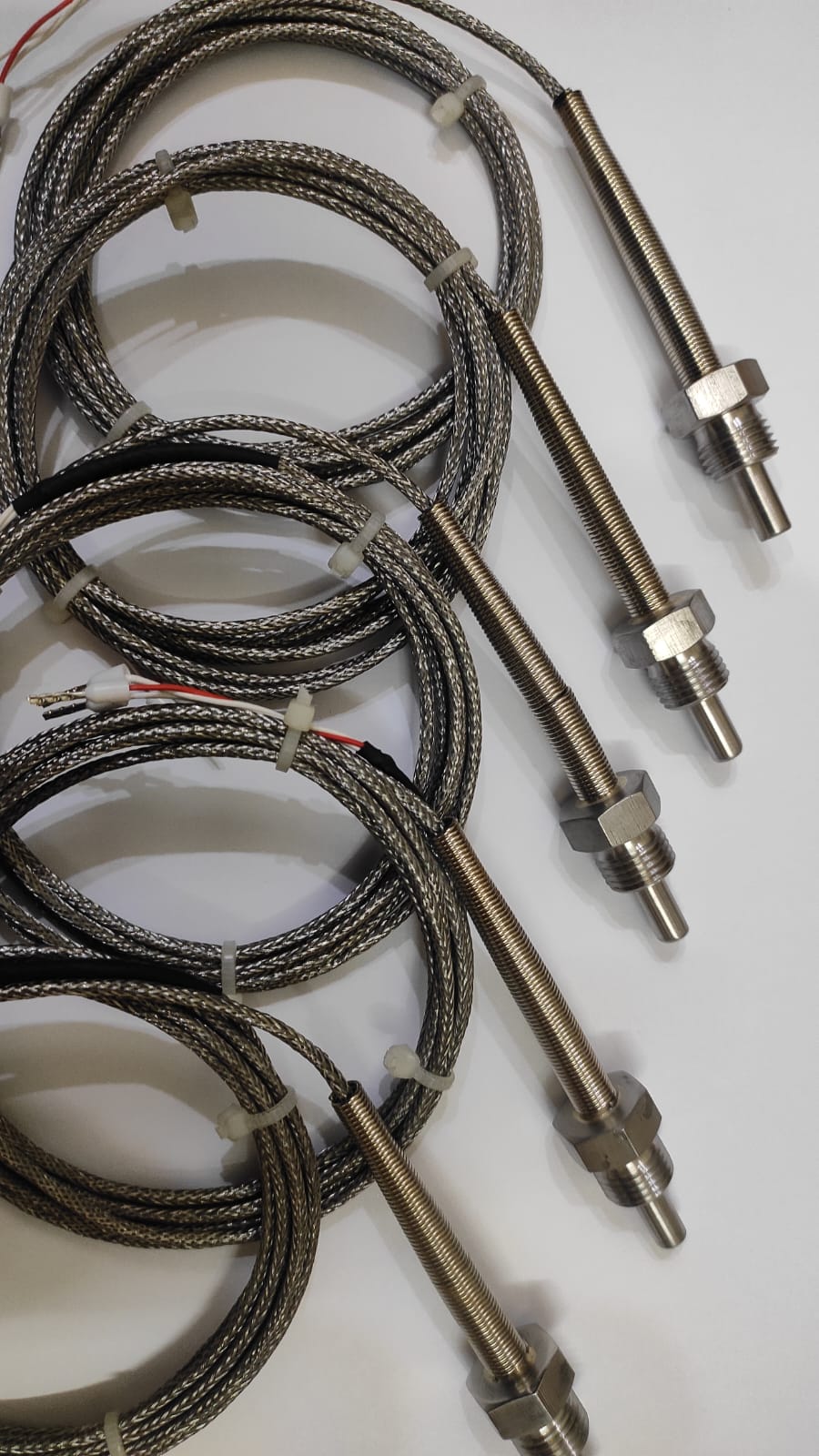
- Wire-type sensors: a compact probe with flexible leads (fiberglass, PTFE or silicone insulated). They suit moulds, hot runners, ovens and tight machinery spaces.
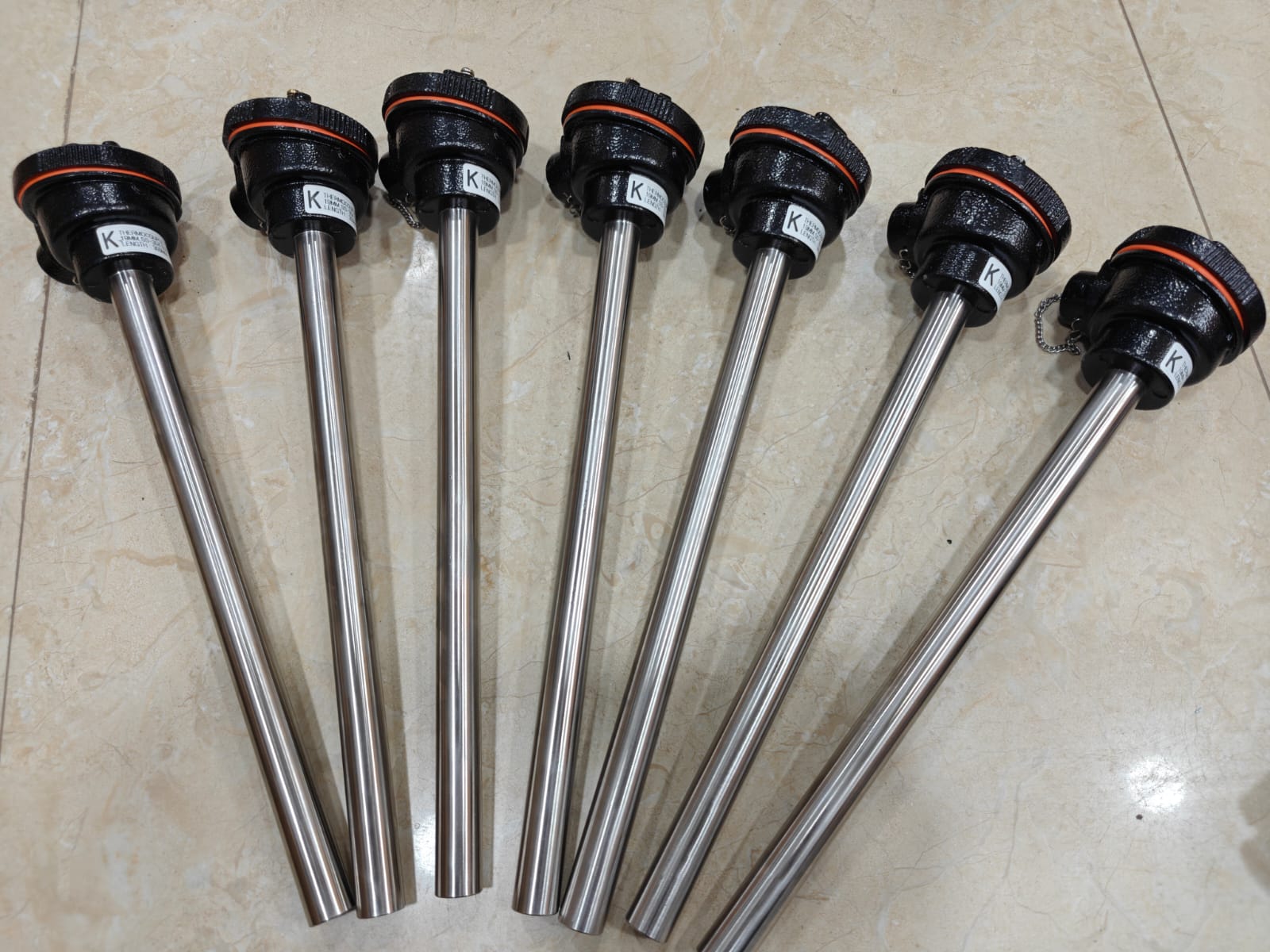
- Head-mounted sensors: a sheathed probe with a terminal head and a process fitting. They suit furnaces, boilers, tanks and process plants where a separate cable runs to the panel. The head can also hold a transmitter.
Don't forget the cable
A good sensor on the wrong cable still gives a wrong reading.
Thermocouple: extension or compensating cable, matched to the type
- The cable must be the same type as the sensor. A Type K sensor needs KX or KC cable, a Type J needs JX, and so on. Plain copper adds an error you cannot see.
- Extension cable uses the same alloys as the thermocouple and is more accurate. Compensating cable uses lower-cost alloys that match only over a limited temperature range; it is the practical choice for R and S types.
- Keep polarity and colour codes consistent. Under IEC 60584-3 the positive core's colour identifies the type (for example, K green, J black, T brown) and the negative is white. Mixing IEC and ANSI colours is a common cause of reversed wiring.
- Near motors and VFDs, use twisted pairs and an overall shield.
Read our extension vs compensating guide, or configure thermocouple extension and compensating cable in J, K, R, S, T and E, including armoured and high-temperature constructions.
RTD: copper multi-core cable, 3-wire or 4-wire, shielded
RTD cable uses copper conductors, but the number of cores matters, because the instrument cannot separate sensor resistance from cable resistance.
- 2-wire: the lead resistance adds straight to the reading. A PT100 changes by roughly 0.385 Ω per °C, so every 1 Ω of lead resistance reads as about 2.6°C too high. Use it only for very short runs.
- 3-wire: the industrial standard. The instrument cancels lead resistance if all three cores are the same size and length.
- 4-wire: removes the effect of lead resistance almost completely. Use it for calibration and high-accuracy loops.
Use a shielded, twisted cable for long runs or electrically noisy areas, and earth the shield at one end only (usually the instrument end). Check loop resistance with our loop resistance calculator, and send us your spec for RTD cable: number of cores, conductor size, insulation, shielding and length.
Lead and outer insulation for hot zones
- Fiberglass cable: our fiberglass cables are rated 250°C standard, higher with special constructions on request. The choice next to furnaces and kilns.
- Silicone cable: flexible and moisture resistant. It reaches 250°C only with a fiberglass outer layer or SS armour. Bare silicone in a furnace zone hardens and cracks.
- PTFE / Teflon cable: chemically inert with excellent dielectric strength. Suits instrumentation, chemical lines and tight panels.
Not sure between the first two? See our fiberglass vs silicone guide.
High-temperature detection: what to tell your supplier
For high-temperature detection, the right sensor depends on your process. When you enquire, share:
- Temperature: normal operating temperature and the maximum it can reach.
- Mounting: immersion length, process connection, and head or flying leads.
- Atmosphere: air, oxidising or reducing gas, molten metal or glass, chemicals, moisture, vibration.
- Signal and distance: cable length, instrument input (thermocouple, PT100 or 4–20 mA), and the temperature along the route.
With these four answers we can propose a high-temperature detection sensor and the cable to match.
FAQ
Can I use copper wire to extend a thermocouple?
No. Copper creates a new junction where it meets the thermocouple wires, which shifts the reference point and causes a reading error. Use extension or compensating cable of the same type as the sensor, for example KX or KC for a Type K.
Is PT100 more accurate than a Type K thermocouple?
In general, yes. Within its temperature range, a PT100 is more accurate and more stable than a Type K. Its tolerance classes are defined in IEC 60751. Type K is the better choice when the temperature is beyond the RTD's range, or when fast response and ruggedness matter more than a fraction of a degree.
What cable do I need for a 3-wire PT100?
A three-core copper cable with all three cores the same size and length, so the instrument can cancel the lead resistance. Use a shielded, twisted cable for long runs or noisy areas, with insulation rated for the temperature along the route.
Which insulation should I use for cable near a furnace?
Fiberglass: 250°C standard on our cables, higher with special constructions on request. Silicone reaches 250°C only with a fiberglass outer layer or SS armour, so don't use bare silicone in a furnace zone.
Should I choose a thermocouple or an RTD for my process?
Choose a thermocouple for high temperatures, fast changes or harsh mounting. Choose an RTD (PT100) for moderate temperatures where accuracy and long-term stability matter most. If you're unsure, send us your temperature range, mounting and cable length and we'll suggest both the sensor and the cable.
Related guides and products
- Fiberglass vs Silicone Cable for High-Heat Applications
- Thermocouple Extension vs Compensating Wire
- RTD sensors (PT100 / PT500 / PT1000)
- Thermocouple extension and compensating cable
- Wire-type thermocouple and Pt100 sensors
- Head-mounted thermocouple and Pt100 sensors
Need the sensor and the cable to match?
Rewari Cable Industries makes thermocouple, RTD, fiberglass, silicone and PTFE cables at our factory in Rewari, Haryana, and supplies wire-type and head-mounted thermocouple and RTD sensors, with an office near Sarai Rohilla, Delhi.
- Configure fiberglass cable and download the TDS for your spec
- Send us your sensor or RTD cable spec, or message us on WhatsApp from any page
Need help choosing? Send us your temperature range, mounting and cable length.
Configure Thermocouple CableAsk on WhatsAppAll guides →